From Black Box to Glass Box: Re-architecting Engineering Trust and IP Capture in the Age of Generative AI
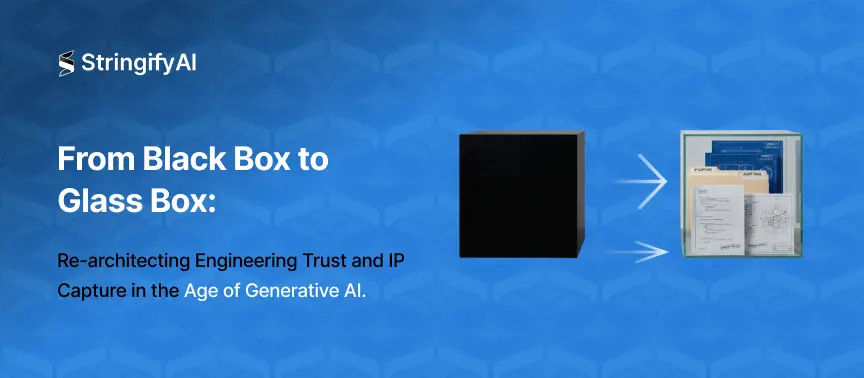
The integration of Generative AI tools into the developer workflow represents the most significant shift in productivity since the adoption of open-source frameworks. This acceleration, however, has triggered a crisis in engineering management: Our current model is a Black Box. We feed requirements on one side and wait for code to come out the other. The proxy we have always relied on to manage this opaque system—time Estimates—is now fundamentally broken.
Senior engineering leaders must recognize that the traditional operating model is no longer viable. The AI era demands a strategic pivot: a shift from an opaque Black Box Model of development to a fully transparent Glass Box system that re-establishes trust, captures intellectual property (IP), and provides validated performance metrics.
The Erosion of Trust: The Black Box in Crisis
The failure of the traditional approach is best illustrated by the two personas AI has created in every engineering team: The Silenced Wizard and The Hallucinator.
The Silenced Wizard is your most efficient engineer. They used AI, like Copilot, to complete a complex refactor in under an hour. Yet, they reported a conservative Estimate of two days. Why? Because the system is designed to punish efficiency. Their "two-day" report protects them from being punished for being too fast, ensuring they maintain the slack needed to handle inevitable interruptions. This padding of Estimates and time sheets fundamentally obscures the true velocity of the team. We lose the valuable intelligence—the prompt strategy—the Wizard used to achieve the efficiency in the first place.
The Hallucinator presents the opposite risk. This developer pastes a requirement into a large language model and reports the task as "Done!". They deliver code that "works," but it contains a ticking time bomb—a deprecated library, an unoptimized query, or a security vulnerability. The code introduces a hidden debt that will cascade into a production failure down the line.
In both scenarios, the engineering system is generating a hidden debt. This leads to False Velocity, where the Project Manager thinks the Silenced Wizard is slow, and the Hallucinator is fast. The management system is actively managing performance, not reality.
The Strategic Imperative: Managing Reality, Not Performance
The core problem is that our metrics are managing a self-reported performance narrative, divorced from the technical reality of the code and the intelligence used to create it. This gap between reported Performance and technical Reality generates the triad of systemic debt:
- Hidden Risk: The code from The Hallucinator is a future production incident.
- False Velocity: The perceived speed of the team is wrong, leading to missed planning targets.
- Lost IP: The high-leverage method used by the Silenced Wizard is never shared or integrated into the organization's institutional knowledge.
The path forward is a strategic reset: we must change the operating model from one based on time and trust to one based on verifiable artifacts and intelligence capture.
Re-architecting the Glass Box Operating Model
The core change is a philosophical one. We stop asking, "How long will this take?". We start asking the executive-level question: "Show me the artifact".
This shift requires two mandatory, non-negotiable protocols:
Protocol 1: The "Show, Don't Tell" Standup
The new rule is simple: "If you cannot show it on a screen, you cannot claim progress". This kills the Theater of Updates where progress is only discussed. Instead, progress is shown.
- Coding: Show the code diff and the tests running.
- Designing: Show the Figma or architectural diagram.
- Investigating: Show the error log or the database query output.
This focuses the entire team on producing verifiable artifacts, immediately anchoring progress to technical Reality.
Protocol 2: The "Prompt-Aware" Definition of Done
To turn the opaque Black Box Model into a Glass Box, we must embed the "recipe" of creation into the source of truth—the Pull Request (PR).
The New Rule: "Every Pull Request must include a "Generation Context"
This captures the intelligence used by the Wizard and transforms it into institutional IP. The PR description must now include:
- Tools Used: (e.g., ChatGPT-4, Copilot).
- Key Prompt/Strategy: (e.g., "Act as a security architect to refactor this module for XSS protection...").
- Human Edit: (e.g., "Agent hallucinated date format; fixed lines 45-50. Added an extra check for null safety.").
This is the mechanism for IP Capture. We don't just want the code; we want the recipe they used to create it.
The Outcome: Transparent Value and Validated Performance
This structured transparency is not micromanagement; it is a system for transparent value.
- For Seniors: Their true expertise is finally validated. Their high-leverage prompting and architectural fixes are now documented, proving their validated performance beyond simple time reports. No more padding estimates to justify their expertise.
- For Juniors: The system provides embedded mentorship. They learn the senior-level prompt strategies from every PR, accelerating their skills.
- For Leadership: They gain Transparent Velocity. They see the real work, not the performance of it.
By moving from a time-based Black Box to an artifact-driven Glass Box, engineering leadership re-architects trust, captures invaluable intellectual property, and anchors its strategic planning in true technical Reality.